From Sacred ‘Community’ to Sacred ‘Individual’: Epigraphic Traces of the Haskalah in Jewish Epitaphs from Bialystok
Invited article for Religions: Special Issue – Jewish Intellectual Traditions in Eastern Europe and the Baltic Region: Between Tradition, Enlightenment, and Modernity
Abstract: This paper asks two questions: What is the nature of the epigraphic traces that suggest the influence of the Haskalah’s ideology? And how do these traces depict or contribute to a portrait of Bialystok’s maskilim and maskilot as remembered in their final epistolary —their epitaphs? The Bialystok epitaphs span the entirety of the Haskalah in Russia (early 19th century to 1880) into the early decades of the 20th century. Of the approximately 50000 Jewish deaths in the years 1800 to 1939, who may have been buried in one of Bialystok’s Jewish cemeteries and marked by a tombstone, only a fraction remain. The small percentage of epitaphs that remain, however, offer such disparate features that suggest varied influences. In particular, this corpus predominately reflects Bialystok’s strong mithnagdic (traditional) community. By contrast, the impact of maskilic thought on the epitaph shifted focus to the uniqueness of the individual, highlighting secular professional achievements and personal tragedies. Within the Bialystok corpus, the following categories are used to explore the epigraphic traces of the Haskalah: (1) maskilic lexicon in the Jewish epitaph; (2) the epitaphs of known maskilim Avraham Ber Gottlober and David Tsvi Solnicki; (3) the epitaphs composed by maskil Eliezer Halberstam; (4) epitaphs focused on secular professions and vernaculars; and (5) those focused on personal tragedies.
“The Devastation of Bialystok’s Bagnowka Jewish Cemetery
and Its Four Ohalim”
Forthcoming 2026. ARCHITEKTURA KULTUR LOKALNYCH POGRANICZA: SACRUM W RUINIE? Polytechnika Bialostocka
In Jewish tradition, one expression for a cemetery is beth olam “house of eternity.” Within this religious institution, rabbinic literature teaches that the matzevah (tombstone) holds a special purpose – to anchor the wavering soul to the decedent until final resurrection. When that matzevah and presumably other sepulchral structures are destroyed, that soul wanders eternally. The last extant Jewish Cemetery in Bialystok, Poland, Bagnowka Beth Olam, in general, was spared the devastation to Jewish cemeteries during World War II by the Nazi regime but less than sixty years later this cemetery would be vandalized and brought to ruins amidst post-World War II Communism continuing into the early 2000s. After briefly revisiting the establishment and growth of Bagnowka from its inception to the final burial in 1969, this paper will examine the evidence for and impact of this vandalism on Bagnowka. The focus of this paper will then turn to the nature and fate of the most visible sepulchral structures on this cemetery, the four ohalim (Rabbinic mausoleums) that once stood on Bagnowka for R. Shmuel Mohilewer (d. 1898); R. Chaim Hertz Halpern (d. 1919), the Kobriner Rabbi, R. Nahum (d. 1919), and R. David Fajans (d. 1935).
“From Bialystok to Kishinev”: The Dubnow grave inscriptions
and their significance for Russian Jewish historiography
and cemetery studies
IUDAICA RUSSICA (ISSN 2657-4861), 2024, nr 2 (13), pp. 1–25
In October 1892, maskil Simon Dubnow published an open letter in Voskhod, the liberal Jewish monthly in Odessa where he worked as a journalist and literary editor. His letter, directed to both the maskilim (intellectuals) and mithnagdim (traditionalists) of his day, appealed to his cohorts to assist in writing the history of Russian Jews as a value distinct from the larger world history of Jewry. The letters Dubnow received in response bear witness to this process of historiography, and many are preserved in The Simon Dubnow Papers, 1632-1938, part of the Edward Blank YIVO Vilna Online Collections. Within Record Group 87, ten folders from Jewish towns spreading from Bialystok to Kishinev were recently re-discovered. These folders include: Bialystok, Gomel, Lipoviets, Lublin, Lutsk, Miedzybozh, Mohilev Podolsk, Ostroha and Stepan, and Kishinev. This paper examines the inscriptions contained in these letters and responds to the simple questions: Why did the zamiers (collectors) select specific epitaphs that they transcribed for Dubnow?, and What value does each gravestone letter hold for Jewish historiography then and now? Full text.
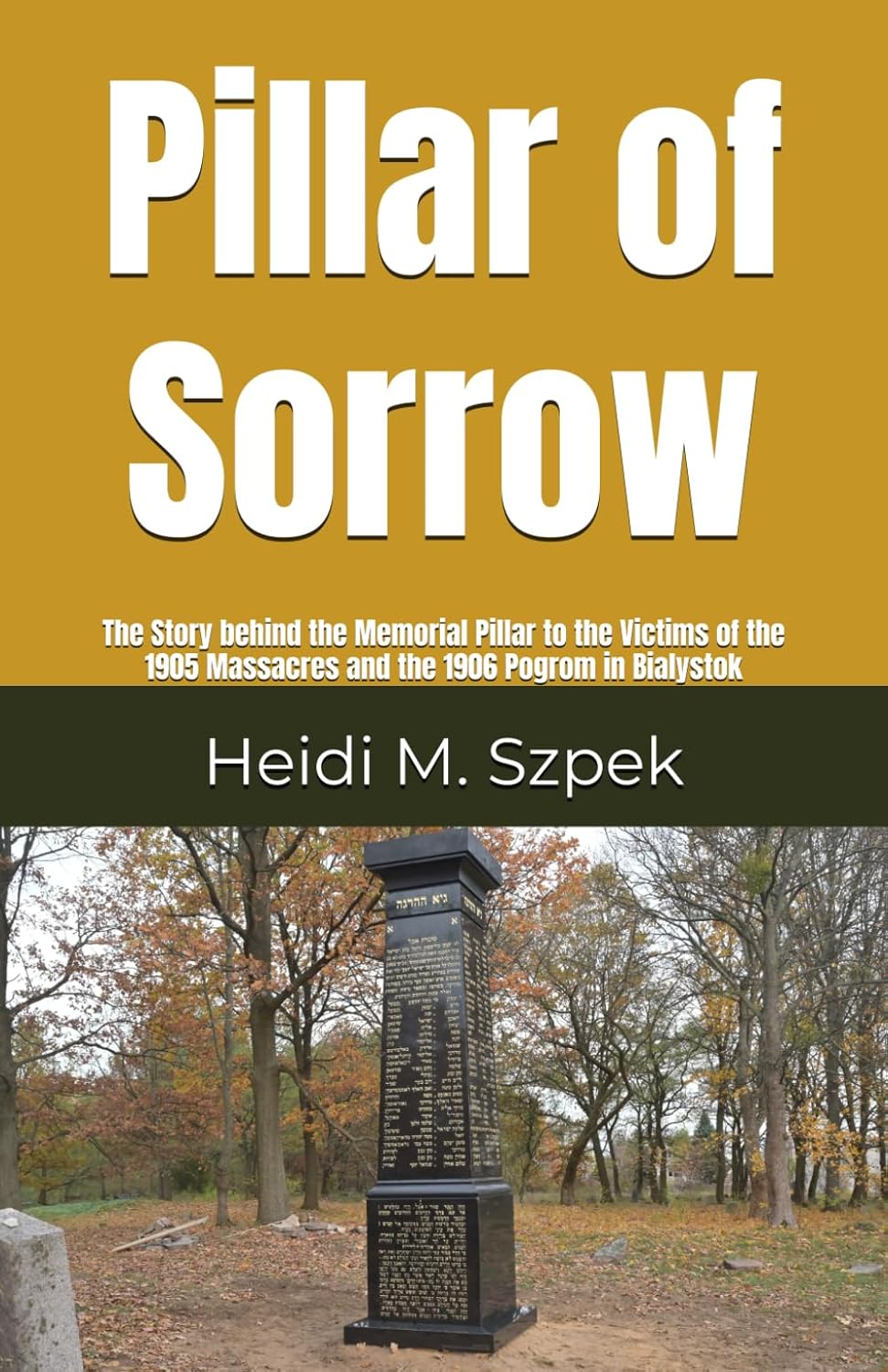
Book Release!! My new book is available through Amazon in paperback and Kindle. Its title derives from the poem by Zalman Shneour on the pillar’s base. This book tells the story of one monument – the Memorial Pillar in Bagnowka Jewish Cemetery in Bialystok, Poland, originally erected to remember many victims of the 1906 Pogrom and two 1905 Massacres. As history progressed, the pillar itself became the victim of vandalism and neglect. Thanks to the efforts of the Bialystok Cemetery Restoration Fund, this memorial was restored in late 2023. It will be rededicated on August 11, 2024.
Ten years ago, this book project began and only recently has the information been available to tell the compelling story of this monument’s turbulent history from the early 20th Century until the present moment. Special thanks must be especially extended to Frank Idzikowski, Beate Schützmann-Krebs, Amy Halpern Degen, Josh Degen, Andrzej Rusewicz, Tomek Wisniewski, The Jewish Place in Bialystok, Jewish Heritage Europe, Ruth Ellen Gruber, Bartosz Markowski, and Filip Szczepański, who assisted in the research and restoration of this provocative monument, as well as a host of others who responded to my occasional, peculiar questions about this monument. July 2024.
Mystery Solved – Almost! Dating the Memorial Pillar: Bagnowka Jewish Cemetery, Białystok, Poland
One of the most prominent features in the Bagnowka Jewish cemetery in Bialystok, Poland is a massive black granite pillar commemorating the scores of victims of the bloody pogrom that took place in June 1906 and two massacres that took place in 1905. An article on the web site of the Museum of Jewish Heritage called the 1906 pogrom “a violent reprisal against the labor movement by Russian authorities in the midst of the Russian Revolution of 1905 to 1906.” At the time, the city was in the Russian Empire and Jews made up a large majority of the local population. Thanks to the US nonprofit Bialystok Cemetery Restoration Fund, the pillar has been restored, and an inauguration ceremony will take place on August 11. In this long-read article hosted by Jewish Heritage Europe on the 118th anniversary the pogrom, the cemetery’s historian Dr. Heidi M. Szpek takes us on a deep dive into the history of the monument, the fruit of nearly 20 years of research. She has discovered who planned and erected the pillar and — almost — resolves the mystery of just when it was installed. She also provides a timeline of its history. June 2024.
And the Pieces Come Together … the 2023 End-of-Year Report of the Bialystok Cemetery Restoration Fund. As 2023 comes to an end, this report details the restoration accomplishments of the US-based Bialystok Cemetery Restoration Fund (BCRF). Despite the utter chaos of our world today, planned and unplanned projects, as well as the discovery of historic details, foundational to this cemetery’s proper restoration, for some inexplicable reason are finally coming together. The discovery, clarification and conjoining of these seemingly disparate pieces was not accomplished by one individual. Rather – to be somewhat cliché, it takes a village. In the case of the BCRF, it is an international village! 2023.
On Art and Restoration As a professor and scholar of Hebrew and Semitic languages, a translator of the Jewish epitaph, a board member of the NGO Bialystok Cemetery Restoration Project, more recently, I’ve taken up a new profession as an aspiring watercolorist. This essay explores how art can be used as a tool to preserve the past, record the present and imagine a future that reconnects to that past. 2022.
“August with Tsvi” – A Restoration Report. Jewish Heritage Europe hosts the 2022 season report of the Bialystok Cemetery Restoration Project. This report includes the incredible news of the extraction of 122 matzevoth from the mound on an unused area of Bagnowka Cemetery.
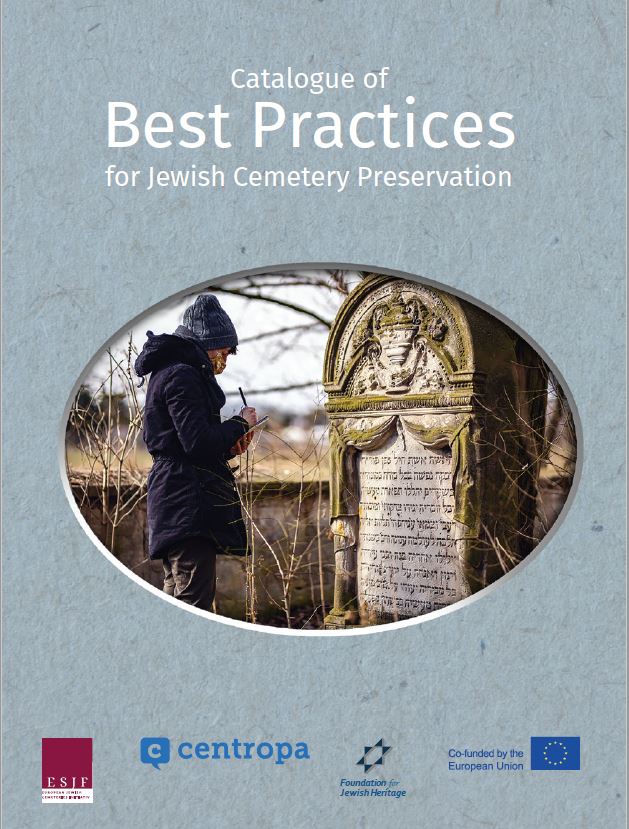
Catalogue of Best Practices for Jewish Cemetery Preservation The ESJF European Jewish Cemeteries Initiative issued a Catalogue of Best Practices for Jewish Cemetery Preservation. The catalogue provides an extensive guide to preservation initiatives from across nine European countries, from small-scale interventions by local residents to transnational partnerships. We are happy to announce that The Good Will Foundation is amongst those initiatives! Our initiative on Bagnowka Jewish Cemetery is found on page 25. 2021.
21 Misconceptions (Corrected) and Fun Facts about Bagnowka Beth Olam in Bialystok, Poland. 2021.
Jewish Past Has a Future in Poland Again, Historiek. Dutch journalist Andre Horling revisits his 1991 trip to Bialystok, including Bagnowka Jewish Cemetery, and interviews Dr. Heidi M. Szpek about current efforts in restoration with the Bialystok Cemetery Restoration Fund. The English translation of the original Dutch article is posted here. 2021.
Jewish Heritage Europe posted my report on How WW2 Luftwaffe Aerial Photos Reveal Lost Jewish Heritage in Bialystok, Poland 2020.
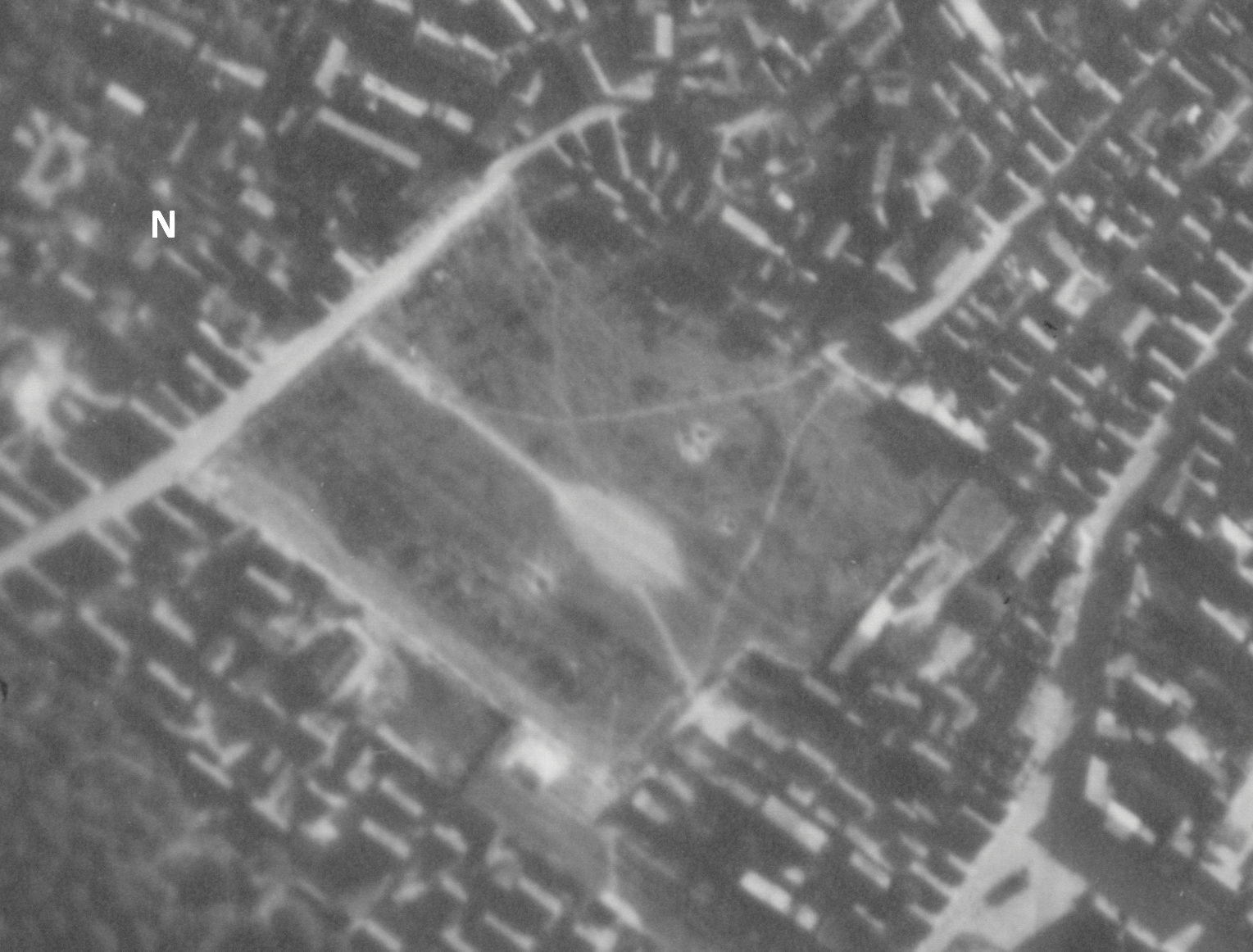
Jewish Heritage Europe has posted our report on Using WW2 Luftwaffe Aerial Photos to Document the History of the Bagnówka Jewish Cemetery in Białystok 2020
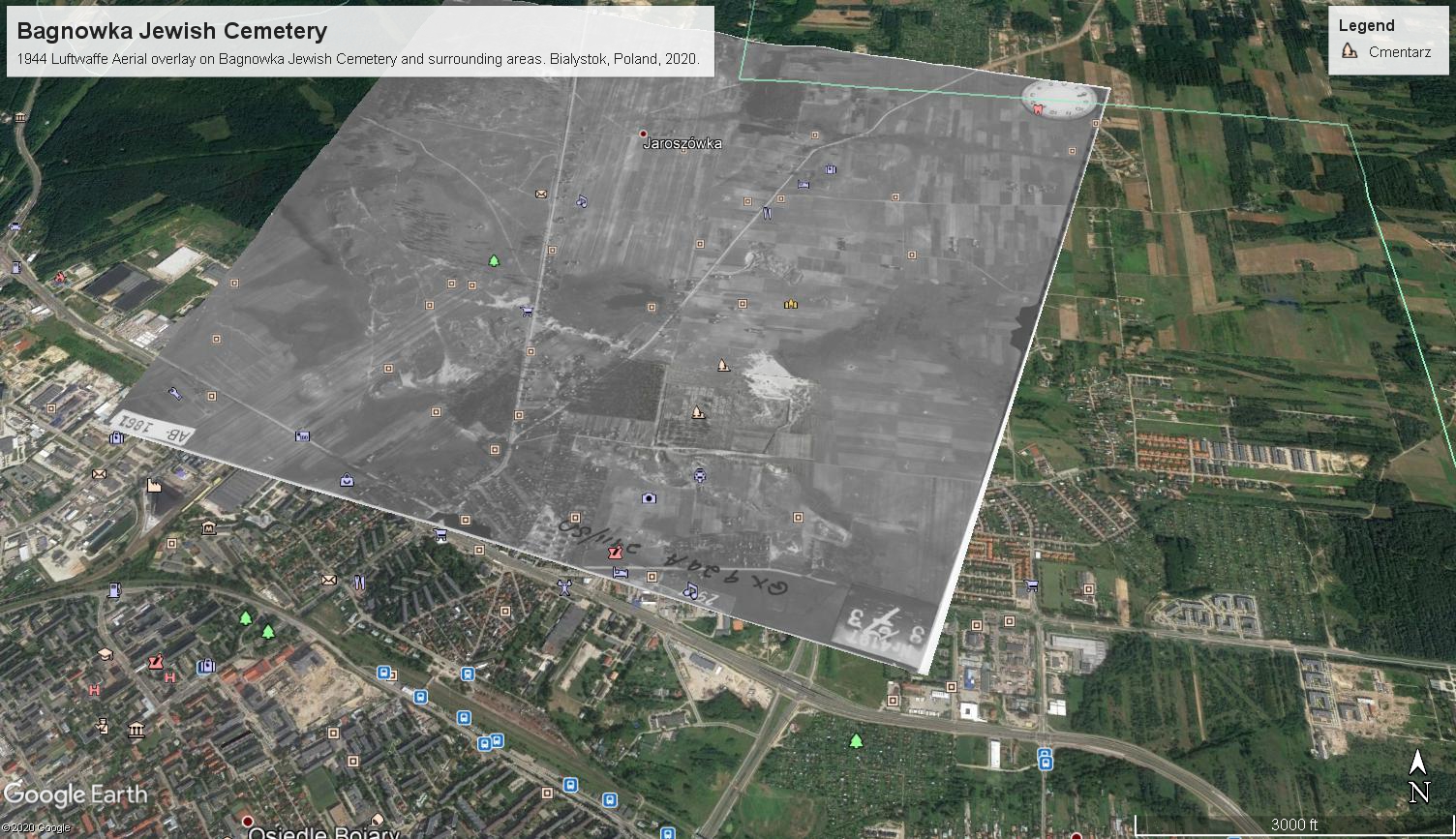
53°09’01.08″ N 23°11’50.56″ E
Book Revision: “Bagnowka: A Modern Jewish Cemetery on the Russian Pale.” 2021.
The ‘Rediscovery’ of the Ohel of Rav Shmuel Mohilever on Bagnowka Cemetery, Bialystok, Poland. 2020.
Looking Back to Move Forward: Revisiting the 1985 Conservators’ Report on Bagnowka Jewish Cemetery in Bialystok, Poland. 2020.
Revisiting the 1985 Conservator’s Report on Bagnowka: Bagnowka had a ‘People Entrance’! 2020.
Best Practices: Bagnowka Summercamp 2019.
“Only in Bialystok!” A Final Report on Summercamp 2019 Restoration Efforts on Bagnowka Jewish Cemetery
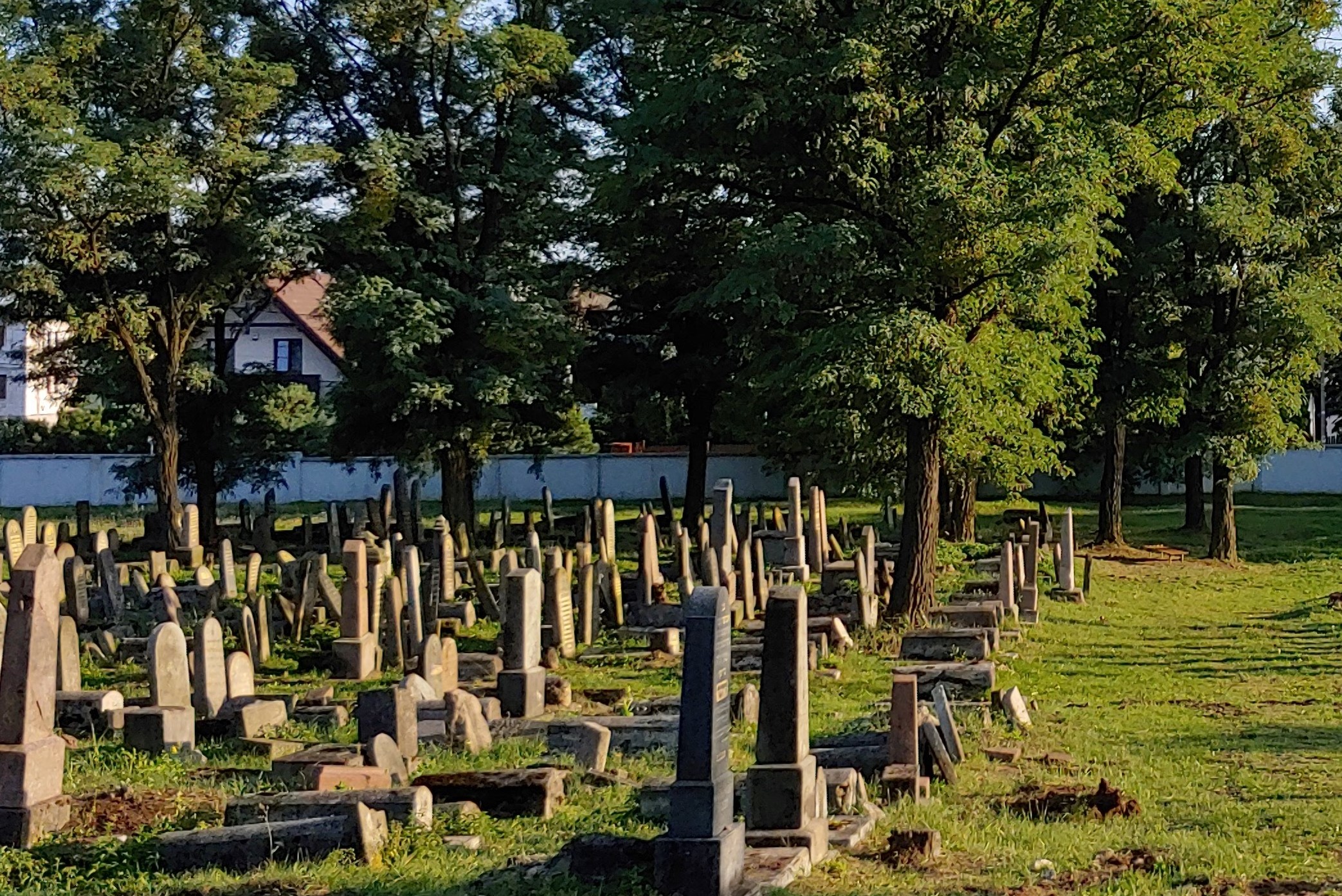
Bagnowka: A Modern Jewish Cemetery on the Russian Pale, IUniverse, 2017.
Bagnowka Cemetery Tour Flier, 2022. Guidebook, 2017, updated 2018.
Dr. Heidi M. Szpek, An Unintentional Keeper of the Names, 2016.
Papers, Articles and Essays of Dr. Heidi M. Szpek. 2006-2018.